Hanoi is one of Southeast Asia's most compelling capitals — a city where centuries-old temples stand shoulder to shoulder with colonial boulevards, where the smell of phở drifts from narrow alleyways, and where the constant hum of motorbikes sets the rhythm of daily life. This guide covers everything you need to know before you go: what to see, where to eat, where to sleep, and how to make the most of your time in one of Asia's most historically layered cities.
Geography & Orientation
Hanoi sits on the western bank of the Red River (Sông Hồng), roughly 1,760 km north of Ho Chi Minh City. The city sprawls across a series of lakes, rivers, and former villages gradually absorbed into the urban fabric. For first-time visitors, it helps to think of Hanoi in three concentric zones:
The Historic Core — the Old Quarter (Hoàn Kiếm District), the French Quarter, and the lakeside areas around Hoan Kiem Lake and West Lake (Hồ Tây)
The Political Center — the Ba Đình district, home to the Ho Chi Minh Mausoleum complex, the Imperial Citadel, and key government institutions
The Outer Residential Belt — Đống Đa, Hai Bà Trưng, and Cầu Giấy, where most locals actually live
Most tourist attractions are concentrated within a 3–4 km radius of Hoan Kiem Lake, making the city surprisingly walkable if you're based in the right neighborhood.
History & Cultural Context
Hanoi's history stretches back over 1,000 years. The city was founded in 1010 when Emperor Lý Thái Tổ moved the capital here from Hoa Lư, reportedly following the vision of a rising dragon above the Red River — which inspired the city's original name, Thăng Long ("Rising Dragon"). This founding story isn't just mythology; it shaped the city's spatial identity, with the Imperial Citadel of Thăng Long remaining its symbolic heart for over eight centuries.
Under French colonial rule (1883–1954), Hanoi was reshaped into the administrative capital of French Indochina. Wide tree-lined boulevards, neoclassical villas, and institutions like the Hanoi Opera House were built in the French Quarter, layering European architecture over the existing Vietnamese urban grain. The result is a visual hybrid that makes Hanoi unlike any other city in the region.
After Vietnamese independence and reunification, Hanoi became the capital of the Socialist Republic of Vietnam in 1976. Today it is a city of over eight million people, blending Confucian traditions, socialist iconography, and a rapidly growing modern economy — all visible at street level if you know where to look.
Must-See Sites & Monuments When Visiting Hanoi
Around Hoan Kiem Lake
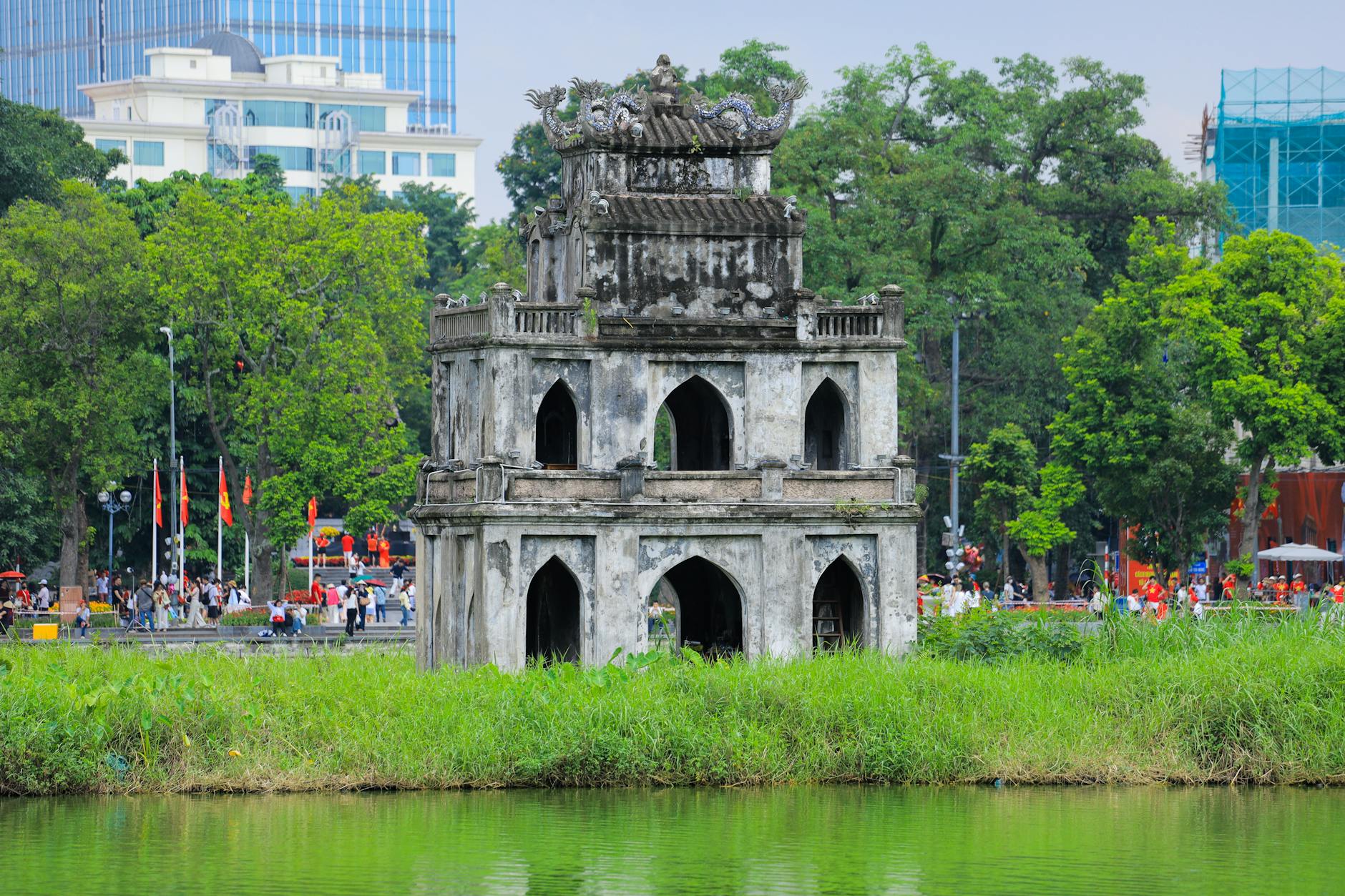
Hoan Kiem Lake is the emotional center of Hanoi — a scenic urban lake whose name, "Lake of the Restored Sword," refers to the legend of Emperor Lê Lợi returning a divine sword to a golden turtle. The lakeside promenade becomes a pedestrian zone on weekends and is the perfect starting point for any visit to Hanoi.
On a small island at the lake's northern end, the Ngoc Son Temple (Temple of the Jade Mountain) is Hanoi's most visited shrine, accessible via a red-painted bridge. Entry is about $1.20 (30,000 VND). Dress modestly — shoulders and knees must be covered.
The Old Quarter
The 36 guild streets of the Old Quarter were historically organized by trade — silk sellers, paper merchants, tin workers — and the street names still reflect this heritage: Hàng Tơ (Silk Street), Hàng Bạc (Silver Street), Hàng Đồng (Copper Street). The neighborhood is dense, chaotic, and endlessly watchable.
Don't miss the Bach Ma Temple, reputed to be the oldest in the city, tucked quietly into the bustle of Hàng Buồm Street. Nearby, the Heritage House (87 Mã Mây Street) is one of the Old Quarter's best-restored traditional merchant homes, offering a rare glimpse of how prosperous Hanoian families lived in the 19th century.
Beyond the Old Quarter
Temple of Literature (Văn Miếu) — Built in 1070, home to Vietnam's first university. Five elegant courtyards, lotus ponds, and 82 remaining stone stelae listing the names of exceptional scholars. Entry $1.80 (45,000 VND). Allow 1–1.5 hours.
Ho Chi Minh Mausoleum — The resting place of the nation's founding leader, "Uncle Ho." Free admission. Closed Mondays, Fridays, and typically from October to late November (body sent to Russia for maintenance). Dress respectfully: no shorts or bare shoulders.
Imperial Citadel of Thăng Long — A UNESCO World Heritage Site dating to the 11th century. The Flag Tower, North Gate, and underground archaeological site at 18 Hoàng Diệu are the highlights.
Hoa Lo Prison Museum ("Hanoi Hilton") — A French colonial prison for Vietnamese revolutionaries, later used for U.S. POWs during the American War, including Senator John McCain. Entry $2 (50,000 VND). Sobering and essential.
National Museum of Vietnamese History — Housed in a Franco-Chinese building designed by Ernest Hébrard. Covers Vietnamese prehistory through the Nguyễn Dynasty (to 1945).
Neighborhoods to Explore in Hanoi
The Old Quarter (Hoàn Kiếm)
The most atmospheric area for first-time visitors, with the highest concentration of guesthouses, street food, and historic sites. Noise levels are high and streets are narrow, but the energy is unmatched. Ta Hien Street (Beer Street) is the nightlife hub; the weekend night market on Hàng Đào runs every Friday to Sunday evening.
The French Quarter
Calmer and more architecturally grand than the Old Quarter, the French Quarter features colonial-era villas, the Hanoi Opera House, the Vietnamese Women's Museum, and upscale dining. Ideal for travelers who want more elegance and less congestion, without straying far from the action.
West Lake (Hồ Tây)
The largest lake in Hanoi, 3 km northwest of the Old Quarter. The shoreline is lined with cafes, upscale restaurants, and boutique hotels. The Tran Quoc Pagoda, built in the 6th century on a small island in the lake, is one of the oldest Buddhist temples in the country (free to visit). The area is notably calmer than the historic center — a good base for families or repeat visitors.
Ba Đình
Home to the major political and historical sites: the Mausoleum, the Presidential Palace, the Ho Chi Minh Museum, and the Citadel. Quieter for accommodation but within easy reach of all central sights.
Food: Eating in Hanoi
Hanoi has one of the most distinct food cultures in Vietnam. Northern cuisine tends to be less sweet and less spiced than its southern counterpart, placing greater emphasis on clean broths, fresh herbs, and subtle balance.
Essential Dishes
Phở bò — Hanoi-style beef noodle soup in a clear, star-anise-scented broth. Try Phở Gia Truyền Bát Đàn (49 Bát Đàn) for one of the city's most acclaimed versions.
Bún chả — Char-grilled pork patties and sliced belly served with vermicelli, fresh herbs, and a dipping broth. Bún Chả Hương Liên (24 Lê Văn Hưu) is the famous spot.
Bánh cuốn — Delicate steamed rice-paper rolls filled with minced pork and mushrooms. Try Bánh Cuốn Gia Truyền Thanh Vân.
Egg coffee (cà phê trứng) — Robusta coffee topped with a whipped egg yolk and condensed milk foam. Invented in 1946 at Café Giang (39 Nguyễn Hữu Huân) during a wartime milk shortage — still the definitive address.
Bia hơi — Ultra-fresh draft beer brewed daily, served at pavement stalls from around $0.25 (6,000 VND) per glass.
Meal Cost Reference
Meal Type | Typical Cost |
|---|---|
Street food / local stall | $1–2.50 (25,000–62,000 VND) |
Local restaurant, full meal | $3–6 (75,000–150,000 VND) |
Mid-range restaurant | $8–20 (200,000–500,000 VND) |
Upscale / rooftop dining | $25–60+ (625,000–1,500,000 VND) |
Nightlife & Evening Activities
Hanoi's evening scene is lively but not late — most venues wind down by midnight or 1 AM.
Ta Hien Street (Beer Street) — The social epicenter of Hanoi nightlife: dozens of open-air bars, bia hơi at $0.25 (6,000 VND) a glass, and a constant buzz of travelers and locals.
Thang Long Water Puppet Theatre — Evening shows at 7 PM or 8 PM, most nights of the week. Traditional water puppetry with live folk music. Tickets $5–10 (125,000–250,000 VND). Book ahead — shows regularly sell out.
Jazz Club by Quyen Van Minh — An intimate venue on Lương Văn Can Street run by master saxophonist Quyền Văn Minh. Shows begin around 9 PM and represent a genuine slice of Hanoi cultural life.
Weekend Night Market — Friday to Sunday evenings on Hàng Đào: food stalls, clothing vendors, handicrafts, and street performances.
Rooftop bars — Multiple boutique hotels in the Old Quarter and French Quarter offer elevated cocktail bars. Expect $4–8 (100,000–200,000 VND) per drink.
Shopping & Crafts
Hanoi is one of Vietnam's best cities for authentic handicrafts and artisan goods.
Hàng Gai ("Silk Street") — Tailors and silk fabric shops. A custom áo dài (traditional Vietnamese dress) can be made in 24–48 hours for $30–80 (750,000–2,000,000 VND).
Đồng Xuân Market — Hanoi's largest covered market. Good for bulk goods, fresh produce, and inexpensive household items. Expect to haggle.
Weekend Night Market — The best browsing spot for lacquerware, embroidered textiles, ceramics, and wooden crafts.
Old Quarter craft streets — Hàng Thiếc (tin goods), Hàng Đồng (bronze and copper), Hàng Trống (drums and lacquerwork) are simultaneously living street museums and functioning shops.
Art galleries around Tràng Tiền Street — Hanoi has a small but serious contemporary art scene, with several reputable galleries in the French Quarter.
Unusual Experiences in Hanoi
Beyond the standard itinerary, Hanoi rewards travelers who look a little closer.
Train Street (Phố Đường Tàu) — A narrow residential lane in the Old Quarter where a diesel train passes within arm's reach of homes twice daily. Sit at a small trackside café and wait for the train. Note: access has been periodically restricted since 2019 — verify conditions locally before visiting.
Morning exercise at Hoan Kiem Lake — At 6 AM, the lakeside fills with Hanoians doing aerobics, fan dancing, laughing yoga, and badminton. Joining in is entirely welcome and costs nothing.
Banana Island (Bãi Giữa) — A green riverbank island in the Red River, accessible via Long Biên Bridge, where local farmers grow bananas and a community of migrants lives in floating houses. An improbable pocket of rural calm 10 minutes from the Old Quarter.
Vespa or Minsk motorcycle tour — Exploring Hanoi's backstreets on the back of a vintage Vespa or Soviet-era Minsk motorbike is a visceral way to experience the city. Operators like Hanoi Backstreet Tours charge $35–50 (875,000–1,250,000 VND) per person.
Egg coffee workshop — Learn to brew traditional Vietnamese cà phê phin (drip filter coffee) and make egg coffee at a specialist café workshop. A hands-on session typically costs $15–20 (375,000–500,000 VND).
Day Trips from Hanoi
Hanoi's central location in northern Vietnam makes it an excellent base for regional exploration.
Destination | Distance | Travel Time | Highlights |
|---|---|---|---|
Hạ Long Bay | 165 km east | ~3.5 hrs | Limestone karsts, boat cruises, kayaking |
Ninh Bình | 90 km south | ~2 hrs | Tràng An gorges, Tam Cốc, ancient Hoa Lư capital |
Sapa | 320 km northwest | 8 hrs bus / 5 hrs train | Rice terraces, trekking, ethnic minority villages |
Mai Châu | 135 km southwest | ~3.5 hrs | Scenic valley, White Thai villages, cycling |
Perfume Pagoda | 70 km southwest | 2 hrs + boat | Sacred pilgrimage site, river journey |
For a single-day excursion without an overnight, Ninh Bình is the most rewarding option: dramatic limestone scenery, river rowing through Tràng An, and ancient temples, all within a two-hour drive.
Practical Information for Visiting Hanoi
Getting There
Nội Bài International Airport (HAN) is 35 km north of the city center.
Taxi or Grab: $7–12 (175,000–300,000 VND), 45–60 minutes
Airport bus (lines 86 and 07): $1.20 (30,000 VND), 45–75 minutes
Private transfer: $15–20 (375,000–500,000 VND), fixed price — best for groups
Getting Around
Grab and Xanh SM (ride-hailing apps) are the most reliable and affordable options for cross-city travel — expect $1–3 (25,000–75,000 VND) for most in-city trips.
Walking works well within the Old Quarter and French Quarter.
Public buses cost $0.40 (10,000 VND) per trip — inexpensive, but route knowledge required.
Weather & Best Time to Visit Hanoi
Season | Months | Conditions |
|---|---|---|
Best | October–April | Cool and dry; October–November optimal (22–28°C) |
Hot & Humid | May–June | Increasing heat, occasional rain |
Rainy Season | July–September | Heavy rainfall, risk of urban flooding |
Cool & Foggy | December–February | Can dip to 10–15°C; misty, atmospheric |
The sweet spot is October to mid-December: comfortable temperatures, low humidity, and the city's green spaces at their most photogenic.
Daily Budget Reference
Traveler Type | Daily Budget (per person) |
|---|---|
Budget backpacker | $25–40 (625,000–1,000,000 VND) |
Mid-range traveler | $55–100 (1,375,000–2,500,000 VND) |
Comfort / boutique | $120–250 (3,000,000–6,250,000 VND) |
Visas
Most nationalities can obtain a Vietnamese e-visa online before arrival, valid for 90 days with single or multiple entries. Always verify current requirements through the official Vietnamese immigration portal before traveling.
Health & Safety
Hanoi is generally safe for travelers. Exercise standard vigilance in crowded areas against pickpocketing. Traffic is the primary hazard: cross streets slowly, make eye contact with motorbike riders, and never assume vehicles will stop for pedestrians. Drink only bottled or filtered water. Travel insurance with medical evacuation coverage is strongly recommended.
Suggested Itineraries
2 Days — Essential Hanoi
Day 1: Morning walk around Hoan Kiem Lake → Ngoc Son Temple → Old Quarter exploration → Bach Ma Temple → lunch at a bún chả stall near Đinh Liệt → afternoon at the Temple of Literature → egg coffee at Café Giang → evening on Ta Hien Beer Street.
Day 2: Ho Chi Minh Mausoleum complex (mornings only) → Imperial Citadel of Thăng Long → Hoa Lo Prison Museum → late afternoon in the French Quarter → evening water puppet show at Thang Long Theatre.
4 Days — Hanoi in Depth
Days 1–2: Follow the 2-day itinerary above.
Day 3: Early morning exercise at Hoan Kiem Lake → Museum of Ethnology → lunch in the French Quarter → Vietnamese Women's Museum → West Lake afternoon (Tran Quoc Pagoda, lakeside walk, sunset rooftop cocktail).
Day 4: Full-day trip to Ninh Bình — Tràng An boat tour, Bích Động Pagoda, Hoa Lư ancient capital. Return to Hanoi by evening.
7 Days — Northern Vietnam Base
Use Hanoi as a hub. Add an overnight cruise in Hạ Long Bay (days 3–4) and a 2-night trip to Sapa or Mai Châu (days 5–6) for highland scenery and ethnic minority culture, before returning for a final day in the capital.